
What is SYMMETRY?Updated 2 months ago

What is Measured:
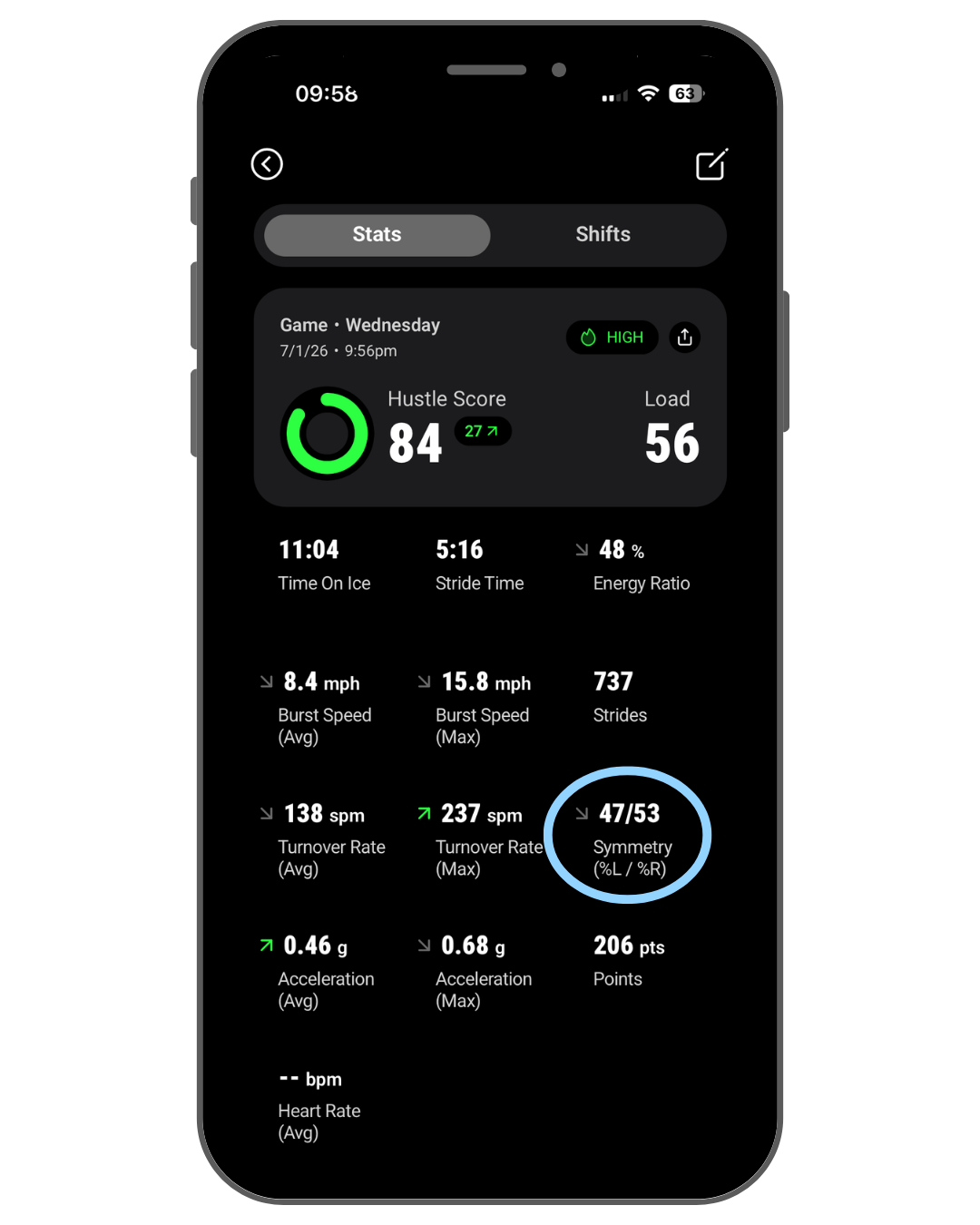
- Symmetry is measured as the ratio of Right vs Left stride output.
- Symmetry measures your left vs. right stride usage rate, not stability or falling.
- In the simplest terms: If a player takes 1,000 strides, what % are right vs left?
What’s Normal?
- Anywhere from 50/50 to 55/45 on either side is within acceptable tolerance.
- Moderate favoritism is normal.
When to Look Deeper:
- Consistently seeing a ratio of 60/40 or greater imbalance.
- This type of data indicates a potential technical inefficiency or muscular compensation.
- Sudden and dramatic change in Symmetry scores may indicate an injury or soreness.
Symmetry in Action:
Common Causes of Poor Symmetry
- Skating posture breakdown.
- Strength differences between right and left leg.
- Lack of edge confidence on one side.
- Lingering physical or mental effects of injury.
Key Coaching Insights
- Sudden changes in Symmetry can be an early indicator of injury.
- Keep an eye on anything greater than 55/45 and manage training accordingly.
Symmetry Data Utilization
- The data can identify hidden asymmetries.
- When you see an imbalance, use that data to guide corrective skating or strength work.
- In the long run, Symmetry data is essential to monitor return-to-play and long-term development.
How to Use It:
- In Rankings by Birth Year (Skills Tab), the percentage shows 50/50 Symmetry compared to peers (0% lowest, 100% best).
- In Session Detail, track Symmetry scores on a shift-by-shift or drill-by-drill basis to proactively flag any sudden imbalances due to an in-game event like a blocked shot or injury.
- In Track Progress, the percentage is a normalized Symmetry score (0% lowest, 100% best), where 100% signifies consistent 50/50 Symmetry across all sessions in that period.